Ethical Dimension of Child Education
Asmaa' Mohd Arshad
Paperback, 154 pages
9789671663745
An Early Example Of Islamization with Reference to Abu Hamid Al-Ghazali
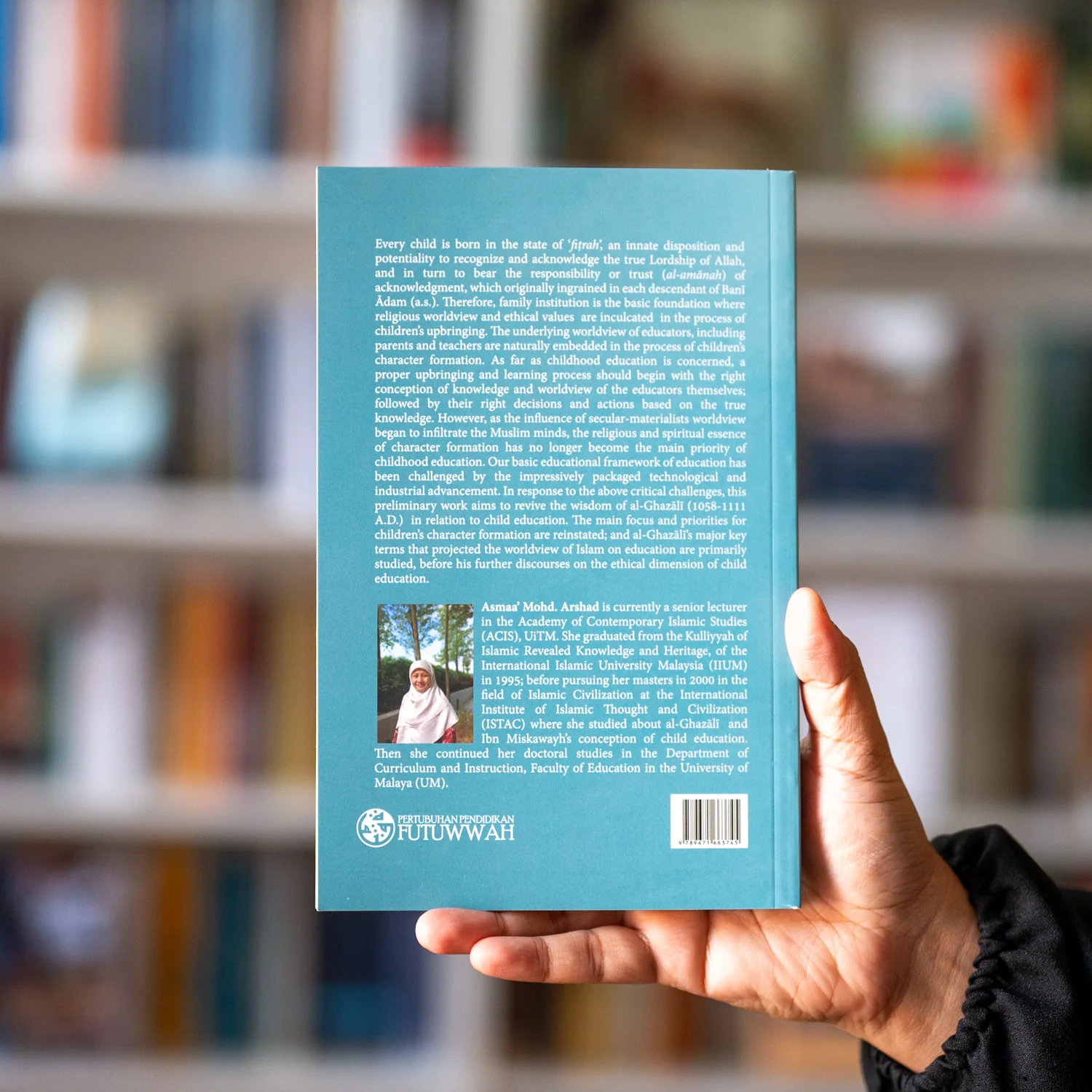
Every child is born in the state of ‘Fiṭrah’, an innate disposition and potentiality to recognize and acknowledge the true Lordship of Allah, and in turn to bear the responsibility or trust (al-amānah) of acknowledgment, which originally ingrained in each descendant of Bani Adam (a.s.). Therefore, the family institution is the basic foundation where a religious worldview and ethical values are inculcated in the process upbringing. The underlying worldview of educators, including parents and teachers are naturally embedded in the process of the child’s character formation. As far as childhood education is concerned, a proper upbringing and learning process should begin with the right conception of knowledge and worldview held by the educators themselves; followed by their right decisions and actions based on true knowledge. However, as the influence of secular-materialist worldviews began to infiltrate Muslim minds, the religious and spiritual essence of character formation has no longer become the main priority of childhood education. Our basic educational framework of education has been challenged by impressively packaged technological and industrial advancement. In response to the above critical challenges, this preliminary work aims to revive the wisdom of al-Ghazali (1058-1111 A.D.) in relation to child education. The main focus and priorities for children’s character formation are reinstated; and al-Ghazali’s major key terms that projected the worldview of Islam on education are primarily studied. This is followed by an exploration of his discourses on the ethical dimension of child education.
Product Information
Product Information
Shipping & Returns
Shipping & Returns



Ethical Dimension of Child Education
Ethical Dimension of Child Education
Asmaa' Mohd Arshad
Paperback, 154 pages
9789671663745
An Early Example Of Islamization with Reference to Abu Hamid Al-Ghazali
Every child is born in the state of ‘Fiṭrah’, an innate disposition and potentiality to recognize and acknowledge the true Lordship of Allah, and in turn to bear the responsibility or trust (al-amānah) of acknowledgment, which originally ingrained in each descendant of Bani Adam (a.s.). Therefore, the family institution is the basic foundation where a religious worldview and ethical values are inculcated in the process upbringing. The underlying worldview of educators, including parents and teachers are naturally embedded in the process of the child’s character formation. As far as childhood education is concerned, a proper upbringing and learning process should begin with the right conception of knowledge and worldview held by the educators themselves; followed by their right decisions and actions based on true knowledge. However, as the influence of secular-materialist worldviews began to infiltrate Muslim minds, the religious and spiritual essence of character formation has no longer become the main priority of childhood education. Our basic educational framework of education has been challenged by impressively packaged technological and industrial advancement. In response to the above critical challenges, this preliminary work aims to revive the wisdom of al-Ghazali (1058-1111 A.D.) in relation to child education. The main focus and priorities for children’s character formation are reinstated; and al-Ghazali’s major key terms that projected the worldview of Islam on education are primarily studied. This is followed by an exploration of his discourses on the ethical dimension of child education.
Original: $14.83
-70%$14.83
$4.45Product Information
Product Information
Shipping & Returns
Shipping & Returns
Description
Asmaa' Mohd Arshad
Paperback, 154 pages
9789671663745
An Early Example Of Islamization with Reference to Abu Hamid Al-Ghazali
Every child is born in the state of ‘Fiṭrah’, an innate disposition and potentiality to recognize and acknowledge the true Lordship of Allah, and in turn to bear the responsibility or trust (al-amānah) of acknowledgment, which originally ingrained in each descendant of Bani Adam (a.s.). Therefore, the family institution is the basic foundation where a religious worldview and ethical values are inculcated in the process upbringing. The underlying worldview of educators, including parents and teachers are naturally embedded in the process of the child’s character formation. As far as childhood education is concerned, a proper upbringing and learning process should begin with the right conception of knowledge and worldview held by the educators themselves; followed by their right decisions and actions based on true knowledge. However, as the influence of secular-materialist worldviews began to infiltrate Muslim minds, the religious and spiritual essence of character formation has no longer become the main priority of childhood education. Our basic educational framework of education has been challenged by impressively packaged technological and industrial advancement. In response to the above critical challenges, this preliminary work aims to revive the wisdom of al-Ghazali (1058-1111 A.D.) in relation to child education. The main focus and priorities for children’s character formation are reinstated; and al-Ghazali’s major key terms that projected the worldview of Islam on education are primarily studied. This is followed by an exploration of his discourses on the ethical dimension of child education.